Cows on water: What a Dutch floating farm can teach Zimbabwe’s farmers
When most farmers think about expanding production, they think about acquiring more land, drilling more boreholes, or increasing inputs. But what if the future of farming lies not in having more resources, but in making better use of the resources we already have?
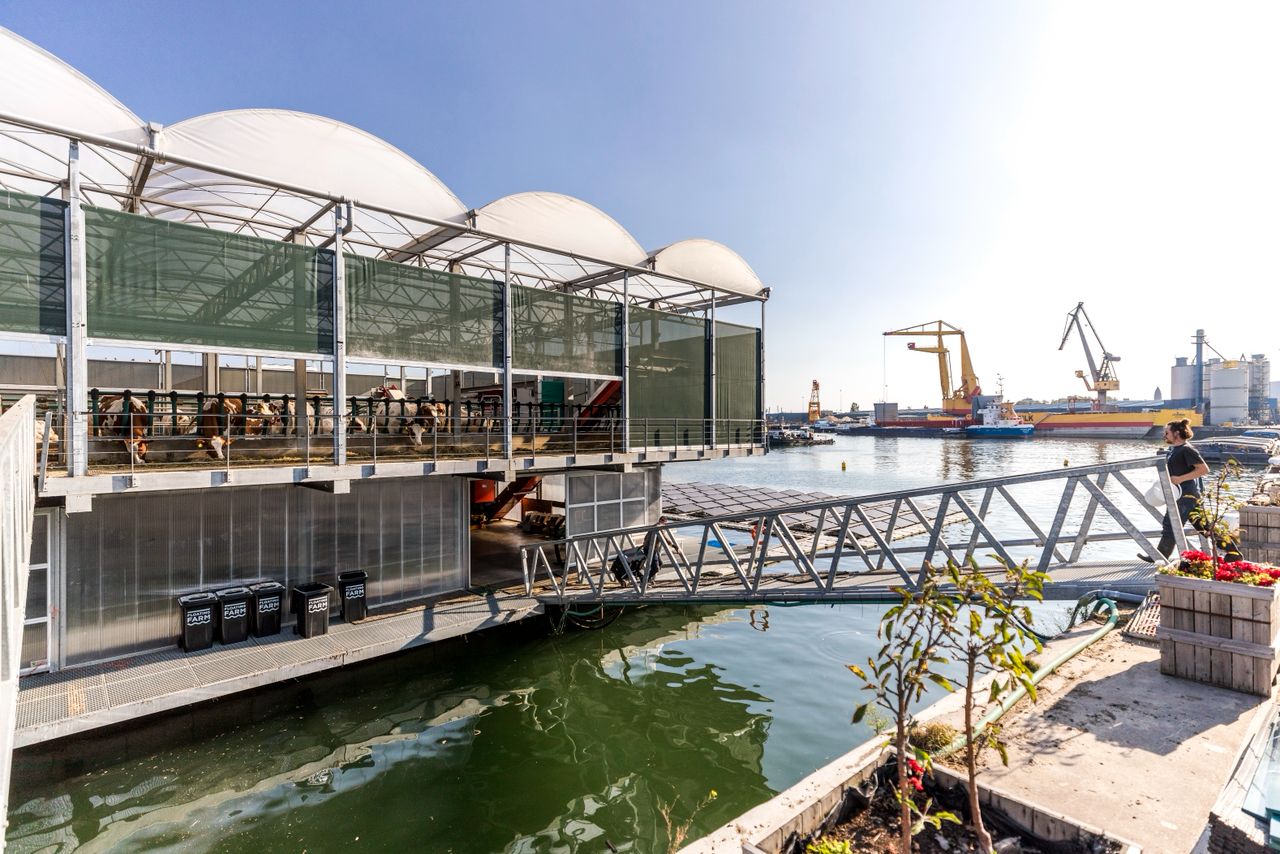
That question is being answered in one of the most unlikely places on earth; a floating dairy farm in the bustling port city of Rotterdam, in the Netherlands.
Featured in the third episode of the fifth series of Clarkson's Farm, the famously sceptical petrolhead-turned-farmer Jeremy Clarkson and his young farming companion Kaleb Cooper travel to Rotterdam to visit a three-storey structure sitting on water in the city's vast harbour. This is the world's first floating dairy farm, home to around 40 cows producing nearly 800 litres of milk every single day. The farm has captured the imagination of viewers around the world, and for good reason. Built on a platform floating in a harbour, it produces milk, recycles waste, generates fresh water and powers itself, all within a city, all within a circle.
The farm is the creation of Peter and Minke van Wingerden, a Dutch couple whose inspiration came not from the Netherlands but from New York City. In 2012, Peter was working on a floating housing project on the Hudson River when Hurricane Sandy tore through the eastern seaboard, flooding streets, collapsing supply chains, and emptying supermarket shelves within days. The lesson was stark: the further food is produced from the people who eat it, the more fragile the system becomes.
"So the idea came up to produce fresh food in a climate-adaptive way on the water," Peter explained. "Because then you can keep producing healthy food for the city, even when there is a flood."
It sounds, at first glance, like a solution to a problem Zimbabwe doesn't have. We are not a maritime nation. Our farmers are not watching sea levels creep toward their pastures. But look closer, and the principles running through the Rotterdam Floating Farm speak directly to challenges Zimbabwean agriculture faces every season.
Nothing wasted, everything cycled - known here as “making a plan”
The most remarkable thing about the Floating Farm is not that it floats. It is that it has reimagined what a farm is.
The Netherlands is one of the world's largest agricultural exporters despite having limited land. Dutch farmers have mastered the art of producing more from less, driven by necessity and innovation. The Floating Farm is perhaps the ultimate expression of that philosophy.
In conventional farming, inputs (feed, water, fertiliser) come in, and waste goes out. The Floating Farm has collapsed that linear model into a circle. In a partnership with the city, the cows are fed on waste products collected from Rotterdam around them: grass clippings from the city's football stadiums (including from the pitch of the famous Feyenoord FC), spent brewing grain from local breweries, potato peel from food processing factories, and stale bread from bakeries. None of it costs the farm a penny. The city produces it. The cows eat it.
"We were wasting so much bread, and now it comes to us," Peter told Clarkson during the visit.
The manure those cows produce is separated, solid from liquid, and processed into organic fertiliser sold to parks, gardens, and agricultural smallholdings around the city. The urine is used to generate the heat needed to desalinate water drawn from the harbour, which is then purified and returned to the cows as drinking water. Floating solar panels, shaped like milk bottles, generate roughly half the farm's electricity.
In short, the Floating Farm does not consume the city around it. It metabolises it.
What this means for Zimbabwe
Zimbabwe's farmers operate in a landscape of resource pressure that would be entirely recognisable to Peter van Wingerden. The cost of commercial feed has risen sharply in recent years, eroding margins for livestock farmers. Water scarcity, exacerbated by increasingly erratic rainfall, haunts every planning decision from the Highveld to Matabeleland. Fertiliser prices, buffeted by global commodity markets, remain a significant burden.
Zimbabwean farmers are already familiar with aspects of circular agriculture, often without using the term. Crop residues feed livestock. Manure fertilises fields. Poultry litter improves soil fertility. Dambo gardens utilise household compost. These are not primitive practices, they are instincts that formal agricultural science in the West is only now rediscovering.
Yet there remains enormous untapped potential here. Could maize stover be processed more effectively as livestock feed? Could tobacco stalks and crop residues contribute to bioenergy systems? Could urban food waste be safely converted into livestock feed or compost? These are questions worth exploring.
The circular economy model demonstrated in Rotterdam is not an exclusively Dutch idea requiring Dutch infrastructure. Its essence is available to any farmer willing to think about their operation as part of a wider system, rather than an island within it.
Water from waste
Perhaps the most striking aspect of the Floating Farm is its approach to water. Fresh water is becoming an increasingly precious commodity worldwide. The farm captures rainwater, recycles and purifies water on-site, and uses the heat generated by processing waste to desalinate harbour water for the cattle.
For a country like Zimbabwe, where recurring droughts and erratic rainfall are becoming the norm rather than the exception, water efficiency is no longer optional. Farmers who succeed in the future will be those who treat every drop as a valuable asset.
Across Zimbabwe, examples of this thinking are already emerging. Water harvesting, drip irrigation, solar-powered pumping, and conservation agriculture practices all improve soil moisture retention. The Floating Farm reminds us that innovation often begins with a simple question: How can we use what we already have more effectively?
Bringing the farm to the city
The Floating Farm is not outside Rotterdam, connected to consumers by a long supply chain. It is inside the city, producing milk that travels metres rather than hundreds of kilometres to reach the table. Van Wingerden sells his dairy products (milk, yogurt, and cheese) only within Rotterdam, under a local brand. The result is a product with no meaningful food miles, maximum freshness, and a story that local consumers understand and value.
Zimbabwe's urban populations are growing. Harare, Bulawayo, Mutare and other cities are expanding, drawing people off the land and into dense urban communities dependent on food transported in from afar. A supply chain disruption, a fuel shortage, a difficult road season - any of these can interrupt what reaches the urban plate.
Peri-urban and urban agriculture already has a foothold in Zimbabwe, but it is often informal and undervalued. The Rotterdam model suggests that farming close to consumers is not a compromise. It is a competitive advantage with fresher product, lower transport costs, stronger relationships with buyers, and greater resilience when rural supply chains falter.
Automation
Clarkson's visit also revealed the farm's embrace of automation. Three robots run the daily operations: one milks the cows on demand ( we see the animals walk in when they feel ready, not when a farmer decides) one distributes feed, and one (which particularly entertained Kaleb) roams the floor collecting manure. Only two human farmers are employed.
"So the cow knows when it wants to be milked and just walks in there?" Clarkson asked, barely concealing his astonishment. "Absolutely," replied Peter.
What makes the Floating Farm even more remarkable is that, for all its urban ingenuity, it has not sacrificed the fundamentals of good animal husbandry. The farm is complemented by a full hectare of grazing land, giving the herd genuine free-range access. The cows move between land and the floating platform as they choose, grazing, resting, and returning at will. The milking parlour sits on the floating farm itself, meaning that when a cow is ready to be milked, she simply walks back on board via the gangplank. It is a system that blends the best of traditional pastoral farming with the realities of a city environment and is proof that innovation and animal welfare are not in competition with each other, but can be designed to work hand in hand.
The economic case for full automation is not yet compelling for most Zimbabwean operations as labour remains a more affordable and more socially important resource here than in the Netherlands. But the underlying principle that technology should reduce the farmer's workload and allow animals to behave according to their nature, is a sound one that can be applied at far smaller scales. Even basic improvements in milking schedules, record-keeping, or feed tracking can meaningfully improve productivity without a robot in sight.
Innovation
One of the most important lessons from Rotterdam is that innovation is not necessarily about expensive technology. Many farmers assume it requires large capital investment. In reality, it often begins with a different way of thinking.
A farmer who converts manure into compost is practising circular agriculture. A farmer who harvests runoff water is improving resource efficiency. A livestock producer who uses crop residues instead of purchasing expensive feed is creating value from waste. The principles are exactly the same. The scale may differ, but the mindset remains unchanged.
When Clarkson left Rotterdam, he said that spending time with the van Wingerdens had convinced him that farming absolutely had to modernise. "If we're going to survive," he said, "we had to change." That is a comment from a man farming in one of the world's wealthier agricultural economies, with access to subsidies, markets, and infrastructure that most Zimbabwean farmers can only observe from a distance. And yet he felt the urgency.
Zimbabwe's farmers, all of whom have navigated hyperinflation, drought, policy upheaval, and global market shocks, are in many ways already experts in circular thinking and making more from less. The Floating Farm shows what happens when those instincts are combined with intentionality: with partnerships, with deliberate system design, where nothing leaves the farm as pure waste.
The most profitable farmers of the future may not be those with the largest farms. They may be those who waste the least.
Food for Thought
What resources on your farm are currently being wasted?
- Crop residues that could feed livestock?
- Livestock manure that could improve soil fertility?
- Rainwater that could be harvested and stored?
- Organic waste that could become compost?
- Underutilised land that could support an additional enterprise?
Sometimes the greatest innovations do not start with new technology, they start with a new way of looking at old problems.
The Floating Farm in Rotterdam was founded by Peter and Minke van Wingerden and opened in 2019. It was featured in Series 5, Episode 3 of Clarkson's Farm

Related Content